
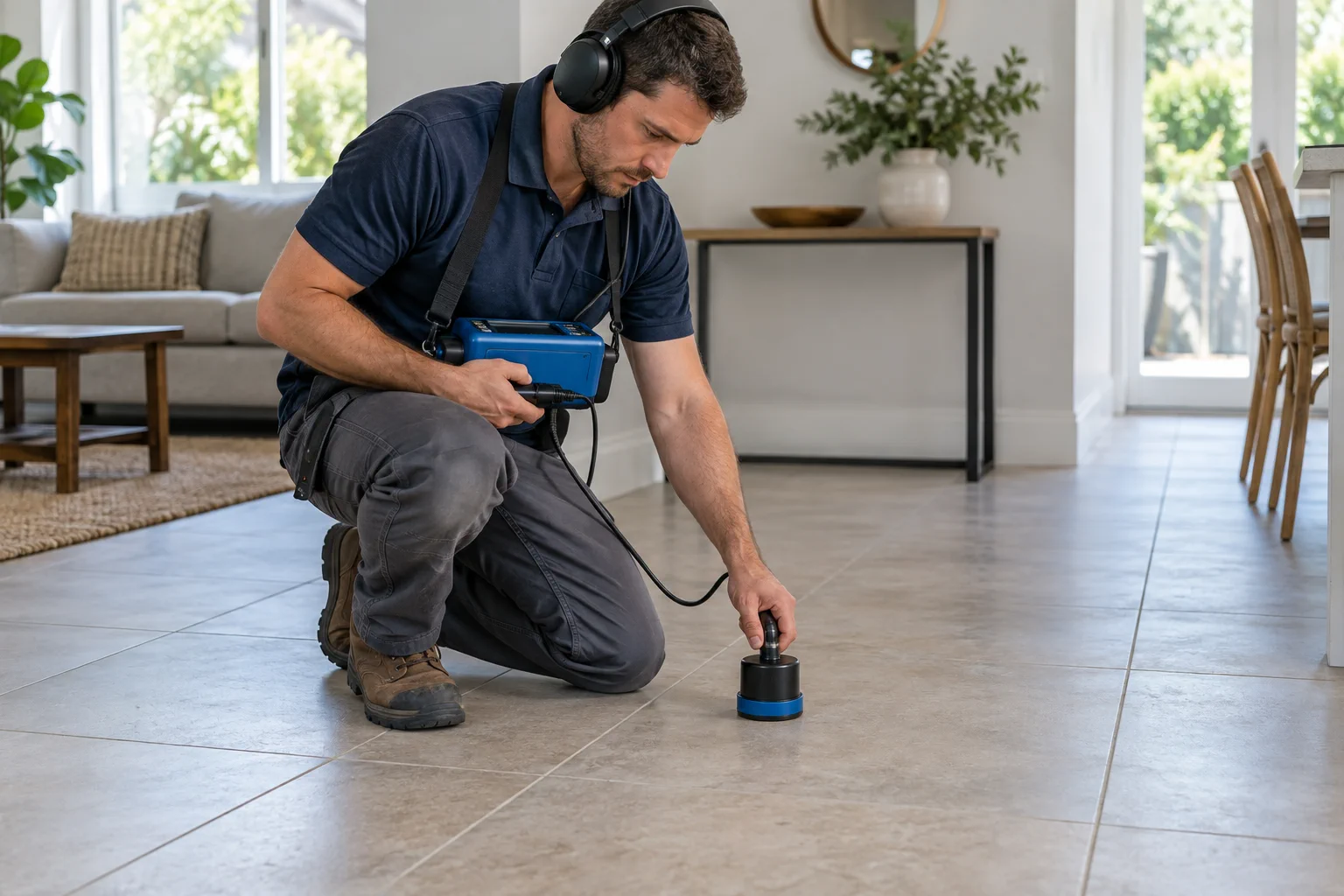
A leak under the slab, explained before anyone opens concrete
If you have a warm or damp spot on your floor, a water bill that climbed for no reason, or you can hear water running when every fixture is off, you may have a slab leak: a breach in the hot or cold water lines running beneath the concrete slab your home sits on. In Redmond, these leaks are most common in homes built from the 1970s through the 1990s, where copper supply lines were run under slab-on-grade foundations and have now had 30–50 years to corrode, rub, and shift.
A slab leak never fixes itself — the pipe keeps wearing at the same spot and the leak gets larger. But it is also not automatically a catastrophe: most are found with non-invasive detection and fixed with a single, planned repair. This page explains how to confirm one, what the repair options actually are, and what drives the cost — so you can call (425) 380-0451 knowing exactly what to ask for.
Signs you may have a slab leak
One symptom alone rarely confirms it — two or more together is when plumbers take it seriously:
- ✓A warm spot on the floor A hot-water line leak warms the concrete and the flooring above it. This is the single most specific slab-leak symptom.
- ✓Damp flooring or recurring wet areas Carpet that stays damp, wood or laminate that cups or warps, tile grout that darkens, in a spot with no fixture nearby.
- ✓The sound of running water with everything off A faint hiss or flow under the floor or inside a wall when no tap, toilet, or appliance is running.
- ✓A water bill that rose without a change in usage Compare this month to the same month last year, not just last month.
- ✓Low water pressure across the house One fixture is a fixture problem; the whole house points to a supply-side leak.
- ✓Cracks in walls or flooring, or a musty smell Moisture wicking up through the slab feeds mold and can shift finishes as soil under the slab moves.
- ✓Your water meter moves when nothing is running The DIY check below that turns suspicion into evidence.
If two or more of these sound familiar, don't wait for visible flooding — slab leaks cause damage quietly, under the floor, for weeks before they show. The next step is detection, not demolition.
The 60-second water meter test (do this before you call)
Turn everything off
Turn off every tap, toilet, dishwasher, washing machine, and irrigation zone.
Read the meter
Find your water meter (usually at the property line in a ground box) and write down the reading.
Wait, then read again
Wait 30–60 minutes without using any water, then read the meter a second time.
Check for movement
If the meter moved, water is leaving your system somewhere it shouldn't — a strong slab-leak indicator.
Bring that result to the call — it tells the plumber this is worth a detection visit, not a guess.
Why slab leaks happen in Redmond homes
- ✓Aging copper under the slab Much of Redmond's housing stock in neighborhoods like Education Hill and Idylwood went up in the 1970s–1990s with copper supply lines buried in or under the slab. After decades, copper pits and pinholes — especially at bends and where it passes through concrete.
- ✓Expansive clay soil and wet winters The eastside's heavy clay soils swell with winter rain and shrink in dry spells. That seasonal movement stresses buried pipe and the joints connecting it.
- ✓Abrasion Where copper touches concrete, rebar, or rock directly, tiny vibrations from water flow wear the pipe wall thin over years — the classic pinhole leak.
- ✓High water pressure Pressure above ~80 psi hammers joints and weak spots. Many Redmond homes have never had a pressure regulator checked.
- ✓Poor original installation Kinked lines, unprotected penetrations through the slab, and buried fittings from the original build fail first.
Newer PEX-plumbed homes are far less prone to this — if your home was built or repiped in the last 15–20 years, a slab leak is less likely (but not impossible).
Service processHow slab leak detection works — no guesswork, no random jackhammering
Detection and repair are two separate jobs. Detection answers where exactly the leak is; only then does anyone talk about opening concrete. A proper detection visit in Redmond looks like this:
History and symptom mapping
Where the warm or damp spot is, when it started, whether it changes with hot-water use, the home's age and pipe material. Your meter-test result goes here.
Pressure testing
The supply lines are isolated and pressurized; a line that won't hold pressure is the leaking one — hot or cold side identified.
Acoustic listening
Sensitive ground microphones pick up the hiss of water escaping under the slab, narrowing the leak to a small area.
Infrared thermography
A thermal camera finds the heat plume from a hot-water leak through the floor — often accurate to within a foot or two, through tile, wood, or carpet.
Confirmation
The plumber marks the spot, explains what was found, and lays out repair options with pricing before any concrete is touched.
Expect a detection and diagnostic fee in the $75–$200 range — this is the step that prevents a $2,000 repair from becoming a $5,000 exploratory demolition.
Your repair options, compared honestly
There is no single "best" fix — it depends on the pipe's age, how many leaks there are, and where the leak sits. These are the four real options, with their tradeoffs:
| Option | What happens | Best when | Disruption |
|---|---|---|---|
| Spot repair | A small section of slab is opened at the marked point, the bad section of pipe is cut out and replaced, concrete is patched | One confirmed leak, pipe otherwise healthy | One patch in the floor; flooring in that area needs refinishing |
| Pipe rerouting | The leaking under-slab line is abandoned and a new line is run overhead — through walls, ceiling, or attic — bypassing the slab entirely | Multiple leaks, or pipe in poor condition overall | No slab demolition; new visible routing, usually inside walls |
| Whole-line replacement / repiping | The aging under-slab system is replaced (often rerouted above the slab in PEX or copper) | Recurring leaks across old copper; the "fix it once" answer | Larger project, but ends the cycle of repeat leaks |
| Epoxy lining (limited cases) | The inside of the pipe is coated to seal pinholes | Very specific pipe conditions; not suitable for every leak | Least invasive, but not a fit for collapsed or badly corroded pipe |
A plumber pushing a single option for every slab leak is selling, not diagnosing. Ask: "Why this option and not rerouting?" — the answer should reference your pipe's condition, not their schedule.
Slab leak repair — Redmond, WA costs and what drives them
These are typical market ranges for slab leak repair, Redmond, WA homeowners can use for planning — honest ranges, not quotes. Your final price is confirmed before work starts, and it depends on the factors below:
- ✓Detection/diagnosis Typically $75–$200.
- ✓Simple spot repair Often $500–$1,500 all-in for an accessible leak.
- ✓Typical full job Industry data (Angi) puts the average around $2,280, with most residential jobs landing $500–$4,000.
- ✓Complex jobs Multiple leaks, reroutes, and foundation complications can run $4,000–$6,750+.
What moves your number up or down: the location of the leak (under an open garage floor vs. under a finished kitchen with tile); hot vs. cold line (hot-side leaks are easier to pinpoint with thermal imaging, sometimes cheaper to fix); the repair method (spot repair is cheapest per job, rerouting costs more upfront but can be cheaper than two future spot repairs on dying pipe); flooring restoration (the plumbing fix and the floor refinish are often separate line items — ask for both in writing); and access (slab thickness, post-tension cables — rare in Redmond residential, but checked — and what sits above the leak).
Get the scope in writing: detection findings, exact repair method, what's excluded (flooring, drywall, permits), and the total. A verbal "around two grand" is not an estimate.
Will homeowners insurance cover it?
Maybe — and the distinction matters. Most policies cover the water damage the leak caused (ruined flooring, drywall, mold remediation) but do not cover fixing the pipe itself if the cause was wear, corrosion, or age. Sudden, accidental pipe failure is treated more favorably than a slow leak that ran for months.
Document everything: photos of symptoms, your meter-test notes, the plumber's written findings — insurers and adjusters work from paperwork. When in doubt, call your agent before authorizing demolition.
When a slab leak is an emergency
Most slab leaks are urgent, not emergent — you usually have days, not minutes. Treat it as a call-today emergency if you see:
- ✓Water actively pooling on floors or seeping through walls
- ✓A sudden, house-wide pressure drop
- ✓New large cracks or a floor that feels like it's shifting
- ✓The smell of sewage (that may be a drain-line issue under the slab, not a supply leak — still urgent)
- ✓Water near electrical outlets or panels
In any of those cases: shut off the main water valve (usually near the meter or where the line enters the house), then call (425) 380-0451. Stopping the flow stops the damage clock.
Preventing the next one
- ✓Have your water pressure tested — anything consistently above 80 psi deserves a regulator.
- ✓Watch the water bill quarterly; a slow creep is the earliest warning system you own.
- ✓During remodels, insist buried copper gets protective sleeves where it passes through concrete.
- ✓If your home still runs original 1970s–80s copper and you've had one slab leak, ask about the economics of rerouting or repiping before the second one — it's almost always cheaper planned than emergency.
- ✓Keep gutters and grading moving water away from the foundation; saturated soil moves more.
Slab leak repair across Redmond
Redmond Flow Plumbing handles slab leak repair, Redmond, WA homeowners in every neighborhood deal with the same way: confirm with detection first, then choose the repair that fits the pipe — not the other way around. The older slab-on-grade homes of Education Hill and Idylwood see the most under-slab copper failures, but the symptoms show up in Downtown Redmond and Overlake homes too. Wherever in the area you are seeing the signs above, the process is identical.
Is it a slab leak — or a different leak?
Not every hidden leak is under the slab, and the repair is completely different depending on where the water is escaping. A stain spreading across a ceiling or down a wall usually points to a pipe inside the building — see wall & ceiling leak repair. A drip at a visible fitting, valve, or accessible line is a pipe leak repair job, not a slab job. The slab-leak pattern is specific: symptoms at floor level, a meter that moves with everything off, and no visible source anywhere in the house.
If the signs are mixed — say, a damp floor and a climbing bill but no warm spot — that is exactly what a leak detection visit is for. Detection separates a slab leak from a wall leak, a drain leak, or a fixture leak before anyone prices a repair, and it is why the first step is never a jackhammer. Guessing wrong here is expensive: opening a slab for a leak that was actually in a wall wastes the one thing detection is designed to protect — your floor.
Questions homeowners ask
The classic combination is a warm or damp spot on the floor, a water bill that rose without extra usage, the sound of running water with every fixture off, or a water meter that moves when nothing is running. Two or more together is enough reason to schedule professional leak detection.
Most residential jobs fall between $500 and $4,000, with industry data averaging around $2,280. Detection itself is usually $75–$200. The final number depends on the leak's location, the repair method chosen, and flooring restoration.
No. The pipe keeps corroding or wearing at the same spot and the leak grows over time. Only the amount of resulting damage changes the longer it runs.
No. Electronic detection with acoustic listening and thermal imaging narrows the leak to a small area, so a spot repair opens one section. If the pipe is failing in multiple places, rerouting above the slab avoids slab demolition entirely.
A straightforward spot repair is usually completed in a day. Rerouting or repiping can take two to several days depending on the home's layout.
Often the resulting water damage is covered, while repairing the pipe itself may not be, especially when the cause was age or corrosion. Document symptoms, meter readings, and the plumber's written findings, and check with your agent before any demolition.
Repair the spot when there is one leak and the rest of the pipe is sound. Reroute or repipe when leaks keep recurring or the pipe is broadly corroded — repeated spot repairs usually cost more than one reroute.
Run a water meter test with all fixtures off, note your symptoms, and call a plumber at (425) 380-0451. If water is actively pooling or pressure has collapsed house-wide, shut off the main valve first, then call.